The Ministry of Planning, Economic Affairs and Development of Trinidad and Tobago was well represented at the inaugural Caribbean Evaluation Space (CEvalSpace) 2026 forum, launched by the Caribbean Development Bank (CDB).
This was a first-of-its-kind regional forum designed to strengthen national evaluation systems, improve decision-making and support stronger public institutions across the Caribbean. This forum was attended by representatives of the Ministry’s National Transformation Unit, who continuously play a major role in strengthening regional institutions and advancing development effectiveness across the Caribbean.
This regional platform convened evaluators, policymakers, development practitioners, academics, civil society leaders and regional partners in September in Barbados, to advance evaluation practice and evidence-informed decision-making in the Caribbean region.
The participants and organisers examined how evidence and learning can improve governance, enhance accountability, and help to deliver better development results. The initiative forms part of the CDB’s commitment to strengthening institutions, a central pillar of the Bank’s 10-year Strategic Plan 2026-2035.
Contributing to the forum was Andrew Spencer, Programme Coordinator – Implementation, of the Ministry’s National Transformation Unit (NTU).
Mr. Spencer focused on government leadership in evaluation, particularly the challenge of balancing strategic direction with a sense of urgency in strengthening national Monitoring and Evaluation (M&E) systems. He emphasised the need to shift from compliance-driven reporting and activity monitoring towards an outcome-oriented learning system, requiring a change in mindset towards evaluative thinking that moves beyond tracking projects and outputs to understanding what is changing, what results are being achieved, and whether public investments are delivering value for money.
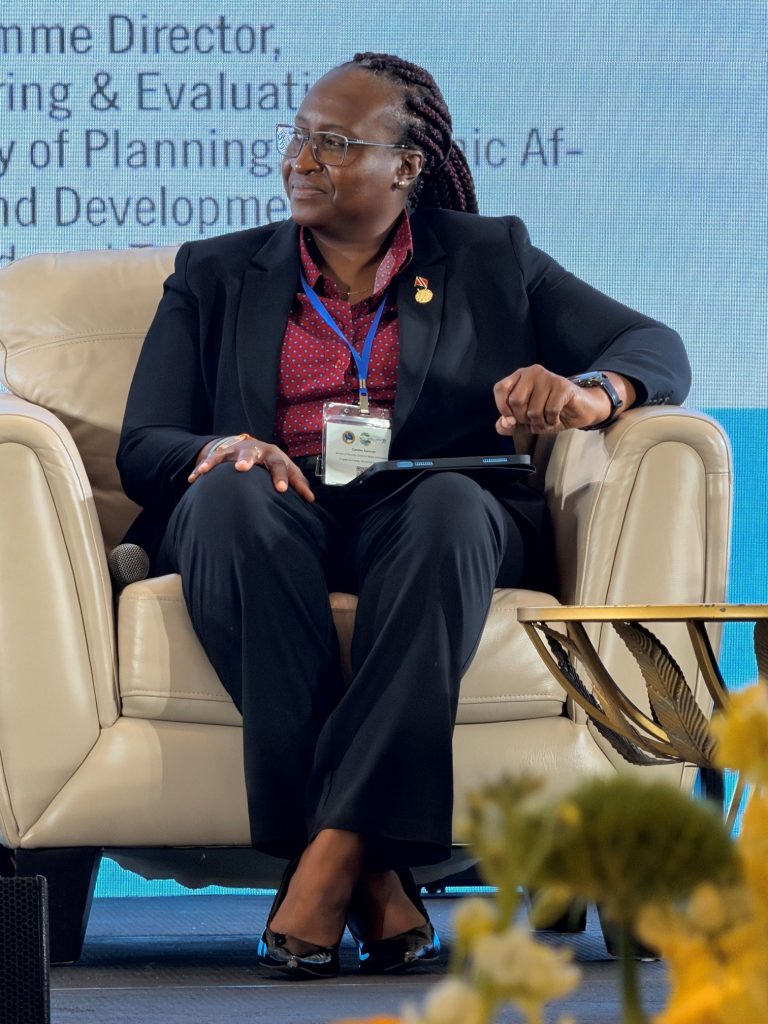
Camille Spencer, Programme Director, Monitoring and Evaluation of the Ministry of Planning, Economic Affairs and Development emphasised the need to make evaluation an integral part of how Caribbean governments lead, learn and make decisions. She highlighted five (5) priorities: creating leadership demand for evidence; embedding evaluation throughout the policy and programme cycle; fostering safe spaces for honest learning; shifting institutional mindsets towards questioning and evaluative thinking; and ensuring that lessons move beyond reports into action. Central to her contribution was the message that evaluation should not feel like an imposed obligation, but a valued practice that helps countries learn, adapt and ultimately deliver better results for their people.
CEvalSpace 2026 was particularly important to the work of the NTU as Trinidad and Tobago is at a critical stage in strengthening its national Monitoring and Evaluation (M&E) system to improve performance measurement and reducing the implementation deficit. The forum provided an opportunity to learn from the experiences of other Caribbean countries facing similar institutional, capacity and resource constraints, while identifying practical approaches to strengthening evaluation systems and promoting the use of evidence in decision-making. Importantly, it reinforced that Trinidad and Tobago’s efforts should not develop in isolation, but can benefit from regional collaboration, shared expertise and peer learning.
Building on the lessons, partnerships and opportunities emerging from the Conference, the NTU will be pursuing the following priority actions:
1. Join the Caribbean Regional Evaluation Community of Practice, representing Trinidad and Tobago, the MPEAD, through the NTU will be participating in the emerging regional network to facilitate knowledge exchange, peer learning, collaboration and the sharing of Caribbean-led evaluation experiences and approaches.
2. Develop and Implement a National M&E System Strengthening Strategy 2026-2027 which will seek to incorporate relevant lessons from the Conference into a practical national strategy focused on strengthening institutional arrangements, evaluation capacity, evidence generation and the use of evaluation findings in public-sector decision-making.
3. Strengthen National Evaluation Capacity and Professional Development of M&E by leveraging regional expertise, partnerships and learning opportunities to support the continued development of public-sector practitioners through the Community of Practice in Monitoring and Evaluation for Trinidad and Tobago (CoMETT), the recently launched M&E Peer Mentoring Programme, and targeted training and competency development.
4. Promoting Caribbean-led Evaluation Knowledge and Collaboration in exploringopportunities for joint research, knowledge products, regional learning exchanges and participation in future Caribbean Evaluation Space initiatives, while sharing Trinidad and Tobago’s experiences, tools and lessons in strengthening national M&E systems.
Overall the NTU intends to translate participation in the Conference into tangible national actions while strengthening Trinidad and Tobago’s contribution to a more connected, collaborative and sustainable Caribbean.